The Joint Admissions and Matriculation Board (JAMB) has officially announced via X (formerly known as Twitter) that the process for converting UTME (Unified Tertiary Matriculation Examination) to Direct Entry (DE) has commenced. The Direct Entry route is ideal for students who want to fast-track their academic progress. Instead of starting from the first year like regular UTME candidates, DE applicants can gain admission into a more advanced level, provided they meet the specific requirements set by both JAMB and the institution they are applying to. Through this process, eligible candidates can upgrade their UTME profile to Direct Entry, allowing them to apply for admission directly into the second year (200 level) of their preferred course in a university or other tertiary institution.
What is Direct Entry?
Direct Entry (DE) is an admission route offered by the Joint Admissions and Matriculation Board (JAMB) in Nigeria. It allows candidates with advanced qualifications (beyond secondary school) to gain admission directly into the second year (200 level) of a university degree program, instead of starting from the first year (100 level) like UTME candidates. It allows qualifications such as:
- Nigeria Certificate in Education (NCE)
- Higher National Diploma (HND)
- Interim Joint Matriculation Board (IJMB)
- National Diploma (ND)
- National Diploma (ND)
Eligibility Criteria for Converting UTME to Direct Entry 2025
For you to upgrade your UTME to Direct Entry, they are certain eligibility criteria that you must meet. These include:
- To apply, you need to have a higher qualification such as an ND, NCE, IJMB, A-level, or any other equivalent qualification recognized by JAMB.
- The grade or CGPA you need may vary depending on the university and the course you are applying for. However, most schools require at least an Upper Credit for ND or HND holders, and a Merit for NCE holders.
- Your qualification should be in a field related to the course you want to study. For example, if you have an NCE in Biology Education, you can apply for a Biology-related course through Direct Entry.
- You must also meet the O’Level requirements, usually at least five credits in relevant subjects, including English Language and Mathematics, depending on the course you are going for.
How to Convert Your JAMB UTME to Direct Entry 2025
You can upgrade your UTME to DE by following these steps:
1. Get the JAMB Direct Entry Form
Start by purchasing the Direct Entry form from any accredited JAMB registration centre or through the JAMB e-facility portal. The price is usually the same as the UTME form, but it may vary slightly each year. Be sure to check the JAMB website for the current fee. You can pay at banks, through online platforms, or via approved JAMB ePin vendors.
2. Register at a JAMB-Accredited Centre
After buying the form, go to an accredited JAMB registration centre to complete your registration. You will be asked to:
- Provide your UTME registration number
- Present your higher qualification (e.g., ND, NCE, IJMB, A-level) for verification
- Upload your O’Level and higher qualification results
- Do your biometric capture and take a photo
- Collect your Direct Entry registration slip as proof
3. Prepare and Submit the Required Documents
Make sure you have the following ready for submission:
- UTME Result Slip – a printout of your UTME score
- O’Level Result – original and photocopy (WAEC, NECO, etc.)
- Higher Qualification Certificate – both the original and a copy of your ND, NCE, or other accepted qualification
- JAMB DE Registration Slip – the slip you received after registration
- Passport Photos – recent passport-sized photos (several copies)
4. Apply to Your Chosen University
After registering with JAMB, apply to the universities you are interested in. Each school has its own application process, which may include:
- Buying the school’s Direct Entry form (usually online)
- Submitting your academic transcripts from your previous school
- Attending a post-DE screening or interview (if required)
5. Take Part in the University’s Screening
Most universities in Nigeria carry out some form of screening for DE candidates. This might include:
- Document Verification – checking the validity of your submitted documents
- Screening Test or Interview – some schools may test or interview applicants
6. Track Your Admission Status
After applying, keep an eye on your admission status through:
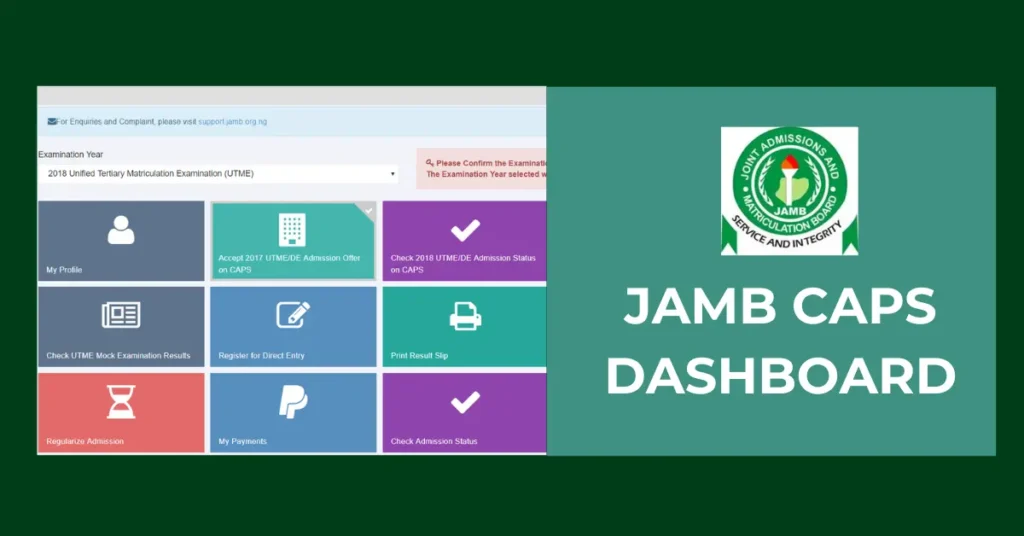
- JAMB CAPS Portal – JAMB’s Central Admissions Processing System (CAPS) tracks all admissions.
- University Admission Portal – Many schools have their own portal where you can check updates.
If you get an admission offer, quickly accept it on CAPS and follow your school’s instructions for registration and payment of acceptance fees.